
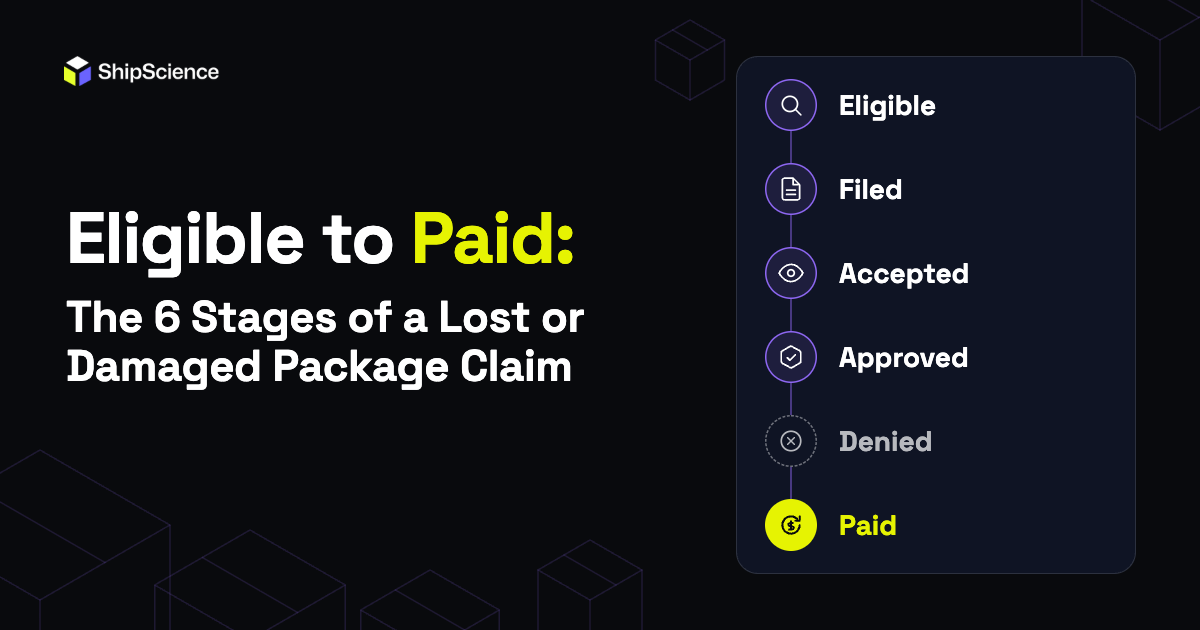
When a package is lost or damaged, you’re out the product, the shipping, and usually the cost of sending a replacement. Filing a lost or damaged package claim is how you get some of those dollars back. UPS, FedEx, USPS, and regional carriers each have their own claims process, with their own forms and deadlines, but every claim goes through the same stages on its way to being paid. ShipScience files and tracks these claims for retailers and brands, so we spend a lot of time watching claims get stuck between those stages.
Eligible: claims you can file
A shipment is eligible for a claim when it was lost or damaged in transit and the carrier’s filing window is still open. Each carrier sets its own window, and once it closes, the carrier won’t accept the claim.
The eligible count is usually the biggest number in a claims report, but it doesn’t tell you much about what you’ll get back. A system might show thousands of eligible claims for a single shipper. Some of those packages will still show up late, which ends the claim (a good outcome, just not a claim payout). Claims missing product details or proof of value are also unlikely to be approved.
Here are the US domestic filing windows for the carriers ShipScience files with, as of November 2026. Each carrier starts the clock at a different point, and carriers update these terms, so check the current versions before you rely on them.
- UPS
- File within 60 days of delivery. If the package never arrived, the 60 days start from the scheduled delivery date. Filing the claim in UPS’s online portal is how you notify UPS, so treat 60 days as the deadline.
- Include the ship date, the tracking number, and what was lost or damaged.
- Once a claim is filed, you have up to nine months from delivery (or scheduled delivery) to send any documents UPS asks for and get it approved.
- FedEx
- Damaged or missing contents: file within 60 days of the ship date.
- Lost or undelivered: file within nine months of the ship date.
- FedEx Freight (LTL) claims follow separate rules.
- USPS
- Damaged or missing contents: file any time up to 60 days after the mailing date.
- Lost: wait 7 days for Priority Mail Express, or 15 days for Priority Mail and Ground Advantage, then file before 60 days from the mailing date.
- Claims apply to insured packages.
- A denied claim can be appealed within 30 days of the decision.
- Amazon Shipping: 60 days for lost or damaged packages. For damage, the clock starts at delivery. For a lost package, it starts at the scheduled delivery date.
- DHL eCommerce: damage claims can be filed right away. For a lost domestic package, wait 21 days, then file within 90 days of the first DHL eCommerce scan.
- DHL Express: 30 days from the date DHL accepted the shipment, for lost or damaged packages.
- OnTrac: 15 calendar days from the expected delivery date.
- Veho: 60 days from delivery, or from the scheduled delivery date if the package never arrived.
- UniUni: claims under its Parcel Protection add-on open 3 business days after delivery and close 30 days later. ShipScience support for UniUni is coming soon.
- GoFo, Jitsu, and Better Trucks: none of these publishes a filing window, so check your carrier agreement (or ask ShipScience about it).
Filed: the claims you acted on
Filing means sending the carrier the tracking number, a description of what was inside, and what it was worth. Most carriers also want proof of value, usually the invoice or receipt. Damage claims also need photos of the damaged box and product. Those usually come from your customer, so ask for them as soon as damage is reported. Some carriers also require a phone call before certain claims can move forward.
Comparing filed claims to eligible claims shows how much of the opportunity you’re going after. The gap between the two often starts outside the shipping team. A customer reports a lost or damaged order, customer service sends a refund or replacement, and the details never reach the people who file claims.
Accepted: the carrier will review it
People often mistake this stage for approval. When a carrier accepts a claim as valid, it has agreed to look at it. It hasn’t agreed to pay anything. During review, the carrier may come back asking for more documents or the recipient’s contact information, and the claim will wait until someone answers.
ShipScience saw this when one shipper filed its first big batch with a regional carrier. All 71 claims were accepted as valid, and the first replies came back with $0 approved. If someone had sent finance a note that week saying “71 claims filed and accepted,” finance would have started counting money that no carrier had agreed to pay. Within a few weeks, about 40 of those claims were approved. So far, that carrier has said yes to 81% of the claims it has ruled on.
Approved: the carrier agreed to pay
An approved claim means the carrier has agreed to pay, and in our experience, the payment usually follows without issue. When the paperwork is in order, approvals can happen quickly. Among new ShipScience customers, the median time from signing to a first approved claim is about 10 days. One large retailer had more than $80,000 in claims paid or approved in its first 11 days.
Approval rates also vary a lot by carrier. The same claim, with the same paperwork, can be approved by one carrier and denied by another. How the claim is filed matters too. One retailer’s FedEx approval rate went from the low 50s before working with ShipScience to 85% within a few months of onboarding.
That’s why ShipScience doesn’t treat the eligible count as a forecast. Our recovery estimates are based on how each carrier has handled claims in the past. If a carrier comes in below that estimate, we tell you which one and how far off we were.
Denied: read the reason before you move on
Carriers deny claims for plenty of reasons: a missing invoice, a missed filing window, a description too vague to verify (“apparel” is a common one), proof that the package was delivered, or a rule only that carrier enforces.
Before you write a denial off, read the reason. When the problem is a missing document, such as damage photos or proof of value, you can often send it and dispute the decision. ShipScience handles these disputes for customers, including a recent wave of USPS denials for “insufficient evidence of value” on claims that already had proof attached. Some denials aren’t worth disputing. When the carrier has proof the package was delivered, the denial is much harder to overturn, and your time is usually better spent on other claims.
[Related: Your Claim got Denied, Why Though?]
Paid: money matched to the claim
A paid claim means the funds are recovered and matched to the claim. Matching is the hard part, especially if you ship with more than one carrier, because carriers pay claims in different ways.
Some carriers pay by electronic transfer and include claim and check numbers in their reporting, which makes reconciliation simple. Others send only physical checks, and gaps in their online reporting can make it impossible to tell which check belongs to which claim. Carriers that only accept claims by email often pay with credit memos sent straight to the shipper’s finance team, which can be hard to connect back to the original claim.
When a payment can’t be matched, the claim it belongs to looks unpaid. At one brand, close to 50 approved claims looked unpaid at the same time while they waited on check numbers. Claims paid in two parts, with one payment for the goods and another for shipping, stay open until both payments are matched. In the meantime, someone on your team may spend time tracking down money that was already recovered.
ShipScience knows how each carrier pays and follows every claim through to payment, so your team doesn’t have to sort out those differences carrier by carrier.
Which lost or damaged package claim metrics to track
Dollars paid out to you is the number that matters most. If you have the data, track every stage so you can see where claims stall:
| Stage | What to track | Why it matters |
|---|---|---|
| Eligible | Claims and dollars you could file | Sets the ceiling |
| Filed | Claims submitted within the filing window | Shows how much of the ceiling you’re acting on |
| Accepted | Claims the carrier agreed to review | Catches paperwork problems early |
| Approved | Claims and dollars approved, by carrier | Shows how each carrier behaves |
| Denied | Denials by carrier and by reason | Shows which denials are worth disputing |
| Paid | Dollars received and matched to claims | The number that reaches your P&L |
| Approved, not matched | Approved claims with no payment matched to them, by age | Your follow-up and reconciliation list |
If your reports don’t have that last row yet, start there. It’s usually a short list, and once it’s cleared, every approved dollar in your reports is matched to a payment.
SimpleClaims, the claims recovery service from ShipScience, tracks each claim from filing to payment and matches every payment back to its claim. Send us 30 days of shipping data and we’ll show you what’s recoverable. You don’t pay anything unless we recover money for you.