
A parcel claim is a request for reimbursement you file with a carrier like UPS, FedEx, or USPS when it loses or damages a package. When this happens, the carrier owes you funds. Standard carrier liability typically covers up to $100 in merchandise value alongside shipping charges for valid loss or damage claims, at no extra cost. While higher coverage limits are available for a fee, purchasing extra protection (ie. insurance) rarely makes financial sense for most shippers. This makes claims one of the few places in parcel shipping where money flows back to the shipper.
Even so, most of that money never gets collected, usually because claims don't have a clear owner. They typically get lumped into late-delivery refunds, bundled into an audit contract, or handed to a logistics team already juggling carrier reviews and peak planning. When nobody is watching the filing deadlines, claims simply expire.
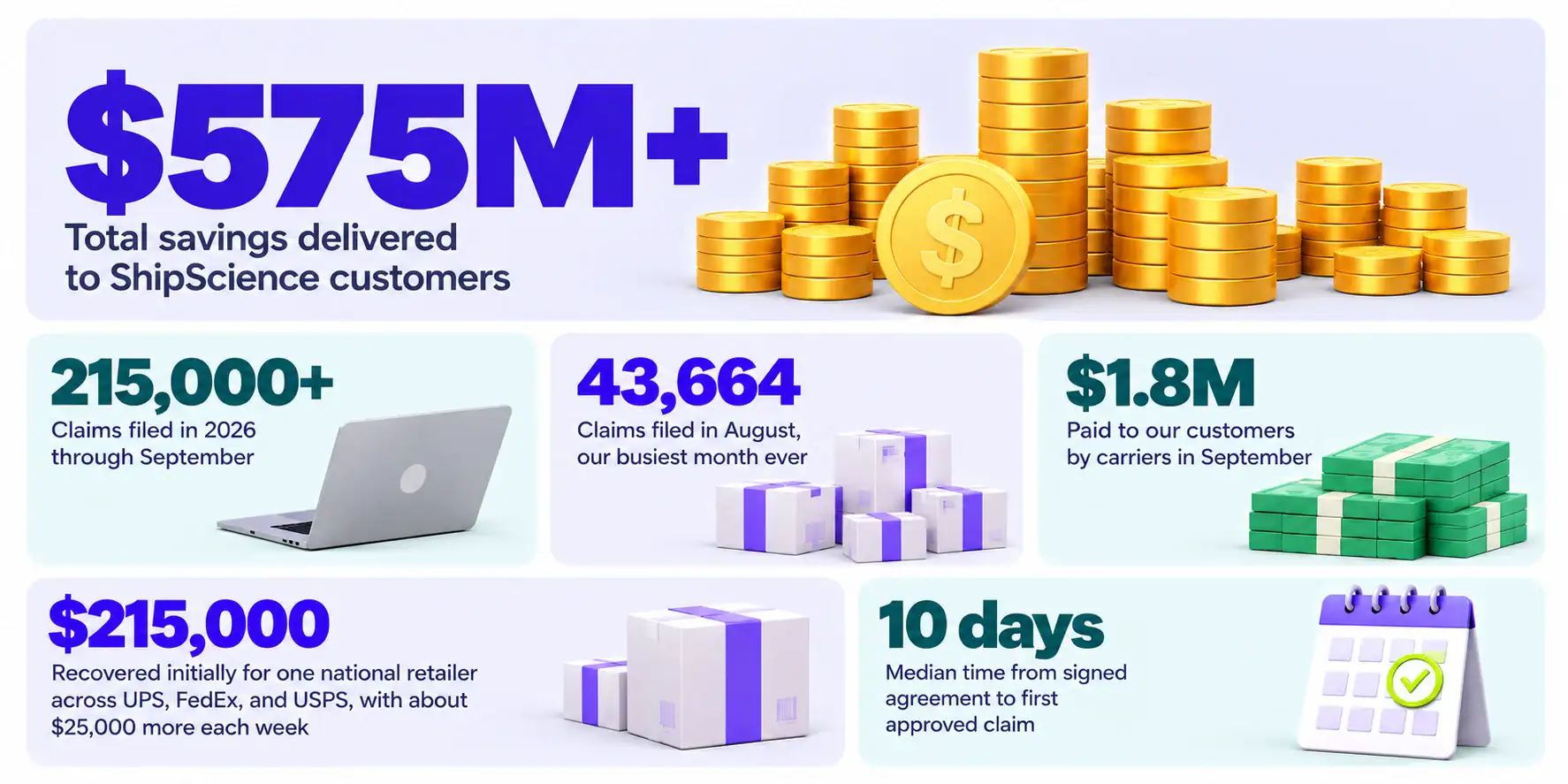
So far this year we've filed more than 215,000 claims for our customers, including 43,664 in August alone, our busiest month ever. As a result, September carrier payments direct to our customers totaled $1.8 million.
The fact of the matter is that none of that $1.8m was actually unattainable to begin with. Carriers owed these reimbursements from the start, and shippers missed them for reasons we hear again and again. We’ve rounded up eight of them below.
Myth 1: Claims are just part of parcel audit
Parcel audit and claims recovery are separate jobs. Audit checks what you were charged:
- Whether the invoice matches your contract
- Whether that residential surcharge was legitimate
- Whether the box really weighed 14 pounds
Claims start with what you shipped.
- What went missing or arrived broken?
- What was it worth?
- Can you prove it before the carrier's filing window closes?
Answering those questions takes product costs, item descriptions, sometimes photos, and a lot of time inside carrier portals.
We offer both: SimpleClaims for lost and damaged packages, and ActiveAudit for invoices. We built them as separate products on purpose, because claims tucked inside an audit tool tend to get side-feature attention. To check your own program, ask your audit provider how many claims it filed for you last quarter. The answer is often lower than people expect.
Myth 2: Claims and refunds are the same thing
A refund or Money Back Guarantee (MBG) and a claim cover different failures, and they pay very differently. If a package arrives a day late on a guaranteed service, you're owed a refund, which comes back as a credit for the shipping charge on a future invoice. If the package never arrives, you're owed a claim, which covers the merchandise itself. The refund on that box might be $14, while the claim could be $114.
The difference matters at contract time too, since carriers negotiate claims terms and service-guarantee terms separately. If your provider reports a single "recovery" number, ask to see claims and refunds broken out. Plenty of programs that look strong on claims turn out to be mostly refunds.
Myth 3: Every automated claims program works the same way
A good share of claims filing sold as “automated” is actually done by hand. Software flags the shipment, and then a person logs into the carrier portal and types in the claim. Because you never see that step, it looks automated from your side. The model holds up at modest volume and starts to strain in November, when claims spike and filing deadlines keep running.
Real automation is hard to build, and we'll be upfront about why. Carriers don't offer APIs for most of the steps a claim requires, so we built and maintain software that works directly inside their portals. We also support regional carriers that only accept claims by email, and we update our workflows every time a carrier changes its rules. For one national retailer, that meant working with UPS and FedEx to set up dedicated claims logins across roughly 4,500 carrier accounts, since a single UPS login maxes out at 999. Setup like that is unglamorous but necessary, which is why we’ve automated it all together.
Ask any provider, including us, to walk you through exactly how a claim is flagged, submitted, and recovered. If the explanation gets vague in the middle, pay attention to that.
See how SimpleClaims files claims automatically — book a demo →
Myth 4: Once a claim is filed, the work is done
Filing is roughly the midpoint. A complete claims program handles six steps:
- Finding lost and damaged packages, including the ones nobody reported
- Gathering the evidence each carrier requires
- Filing before the window closes
- Disputing denials, many of which can be overturned with the right documentation
- Tracking every claim through to payment
- Matching each carrier payment to the shipments it covers
The first step is where a surprising amount of money slips away. When an order doesn't arrive, the customer contacts support, gets a replacement, and moves on. Your service team did its job, but nobody told the carrier it owes you for the original package.
Finance cares most about the last step. Carriers pay claims in lump sums, often a single deposit covering hundreds of claims, with remittance detail that ranges from decent to useless. Without matching each payment to its shipments, no one can tell which claims were paid in full, which were short-paid, and which were never paid at all. This process makes reconciliation that much more difficult for finance teams, who don't have the bandwidth to chase down the details. With SimpleClaims, CFOs and finance leaders have all the information they need to reconcile each payment.
Myth 5: Claims aren't worth much
Claims seem small because the unfiled ones never show up on a report (ie, you don’t know what you don’t have visibility into).
Because claims look small, some shippers actually give them away at the negotiating table. They agree to waive their right to file, either because chasing claims is a pain in itself or because the carrier offers a better rate or an extra discount in exchange. It's one of the costliest trades in parcel shipping. If claims are worth 2-3% of your spend and the waiver buys you one more point of discount, you've handed the carrier the difference every year for the life of the contract. Once filing is automated, the hassle that made the waiver tempting mostly goes away.
Shippers who do file often collect far less than they're owed. When claims are filed by hand, the easy ones get done and the rest wait. Some go in without the right documentation and get denied, and others miss the filing window entirely. Without clear reporting on what was filed, approved, and paid, it's hard to even tell the program is falling short. Closing those gaps adds up quickly.
For most high-volume shippers, eligible lost and damaged package claims add up to about 2 to 3 percent of parcel spend. On a $20 million parcel budget, that's $400,000 to $600,000 a year, money most companies would fight hard for anywhere else in the budget.
Estimate what your carriers owe you with our SimpleClaims ROI calculator →
Myth 6: Insurance already covers it
Shipping insurance and carrier liability are two different things. UPS and FedEx are typically liable for up to $100 per package, or more if you declare a higher value, and that holds whether or not you carry a policy. Sending those losses to your insurer instead means paying a deductible and adding to your loss history for money the carrier already owes. Insurance works best for what carrier liability won't cover. A good claims program routes each loss to the right place, and the documentation it builds supports both.
Myth 7: Adding a claims provider means a long integration project
This one usually comes from experience. Most shippers have lived through a TMS, WMS, or ERP rollout that took months and a dedicated IT team, so they assume anything touching carrier data works the same way. Claims recovery needs far less. A good provider typically needs three things: access to your carrier accounts (often through a dedicated claims login), your shipment and tracking data, and product values from your commerce platform or ERP so each claim is filed for what the item was actually worth. None of that means replacing a system or writing custom code.
The bigger risk is waiting. Because carrier filing windows are short, every week a project sits in an IT queue is another week of eligible claims that age out for good. When you do start, ask whether the provider will go back through the window that's still open, so recent losses get filed instead of written off.
Shameless plug: SimpleClaims connects to the carriers and commerce platforms you already use, so there's nothing to replace and no integration fee. Our median time from signed agreement to first approved claim is 10 days, and one enterprise clothing retailer recovered $60K in the first weekend they were live with SimpleClaims.
Fun fact: We’re paid only when you are, so our incentives match yours. No platform cost, no service fees. This keeps us motivated to save you as much as we possibly can.
Myth 8: We can build this ourselves, especially now with AI
This is the most common objection we hear, and AI has made it sound more convincing than ever. A capable engineer can get a first version running in a few weeks: pull tracking data, flag shipments that look lost, draft the claim. The hard part starts after that.
Like we stated in Myth #3, carriers don't offer claims-filing APIs, so every claim still has to go through a portal or an inbox. Each carrier wants different documentation, and some change their requirements by service level. Then come the edge cases: multi-package shipments, partial deliveries, reshipments, packages marked delivered that never showed up, denials that need a second pass. There are dozens of them, and they shift every time a carrier updates its portal or its rules. AI can help with pieces of that, but it can't get around a portal that was never built for automation, and teaching it every exception takes months of human review.
Then there's year two. The tool that started as a side project turns into someone's full-time maintenance job, and when that person changes roles, nobody owns it. Claims start slipping through again, and it can take a while before anyone notices. We've been building SimpleClaims for more than five years with a team of 6-10 engineers, and they still work on it every week, because the carriers never stop changing (are we right, or are we right).
The same thinking applies to teams that handle claims with one or two people today. The process can feel under control, but without something to compare against, it's hard to see what's being missed. Those people usually know your shipping better than anyone, so taking filing off their plate gives them time to fix what’s causing claims and a clear recovery number to bring to leadership.
Before you build, or decide the current setup is good enough, ask who will own it two years from now and whether that's budgeted, how you'll know when a carrier change breaks something, and what each missed filing window costs while it's broken. If those answers are fuzzy, building will risk more than you think.
Six questions to ask about any claims program
Whoever handles your claims today, these questions will show you where you stand:
- How many of my claims last quarter were filed automatically, and how many needed a person?
- Can I see claims separately from late-delivery refunds?
- How many eligible lost or damaged shipments went unfiled, and why?
- What's my approval rate, and what happens after a denial?
- Can every carrier payment be matched to the shipments it covered?
- Which of my carriers are covered today?
A strong program can answer every one of these with numbers. For instance, ShipScience’s average claims approval rate is 80%. Vague answers usually mean there's money you haven't collected yet.
Where ShipScience fits
Most customers come to us for claims, and many end up using us for much more. SimpleClaims finds, files, and follows every claim automatically and typically recovers 2 to 3 percent of parcel spend, without anyone on your team filling out a form.
Once recoveries start coming in, the next question is usually where else the shipping budget is leaking. ActiveAudit and our analytics tools catch billing errors and overcharges on carrier invoices, and our expert services team works as an extension of your transportation team on contracts and carrier selection. From the first claim to the next contract, the goal is to keep more of every shipping dollar in your business.
The numbers so far
Parcel claims FAQ
What is a parcel claim?
A parcel claim asks a carrier like UPS, FedEx, or USPS to pay you back for a package it lost or damaged. An approved claim covers the item’s value and the shipping cost, up to the carrier’s liability limit. That limit is often $100 per package unless you declared a higher value.
How long do I have to file a lost or damaged package claim?
Filing deadlines depend on the carrier and the service level, and many close within 60 days. A claim submitted after the deadline is denied even if it’s valid. The safest approach is to file as soon as a loss is found.
What's the difference between a shipping claim and a shipping refund?
A shipping refund gives back the shipping charge when a guaranteed delivery arrives late, usually as a credit on a later invoice. A shipping claim pays for the goods in a package that was lost or damaged, and the carrier pays it separately. Per package, claims are usually worth much more than refunds.
How much can a shipper recover from parcel claims?
High-volume shippers can typically recover 2 to 3 percent of their annual parcel spend through lost and damaged package claims. For example, a company spending $10 million a year on parcel shipping could be owed $200,000 to $300,000.
Can we build our own claims automation with AI?
An engineering team can build a basic claims tool with AI in a few weeks, but keeping it accurate over time is difficult. Carriers have no claims-filing APIs, each one asks for different documentation, and their portals and rules change often. Ongoing maintenance, plus claims missed while the tool is broken, usually costs more than the original build.
Find out what your carriers owe you
Send us your shipment data and we'll show you what's recoverable, including claims still inside the filing window. There's no integration, services, or platform fee, and you pay nothing unless we recover reimbursements.