
Most enterprise shippers enter carrier contract renewals confident their claims recovery is solid.
They have a process. Claims get filed. Money comes back. The team handles it.
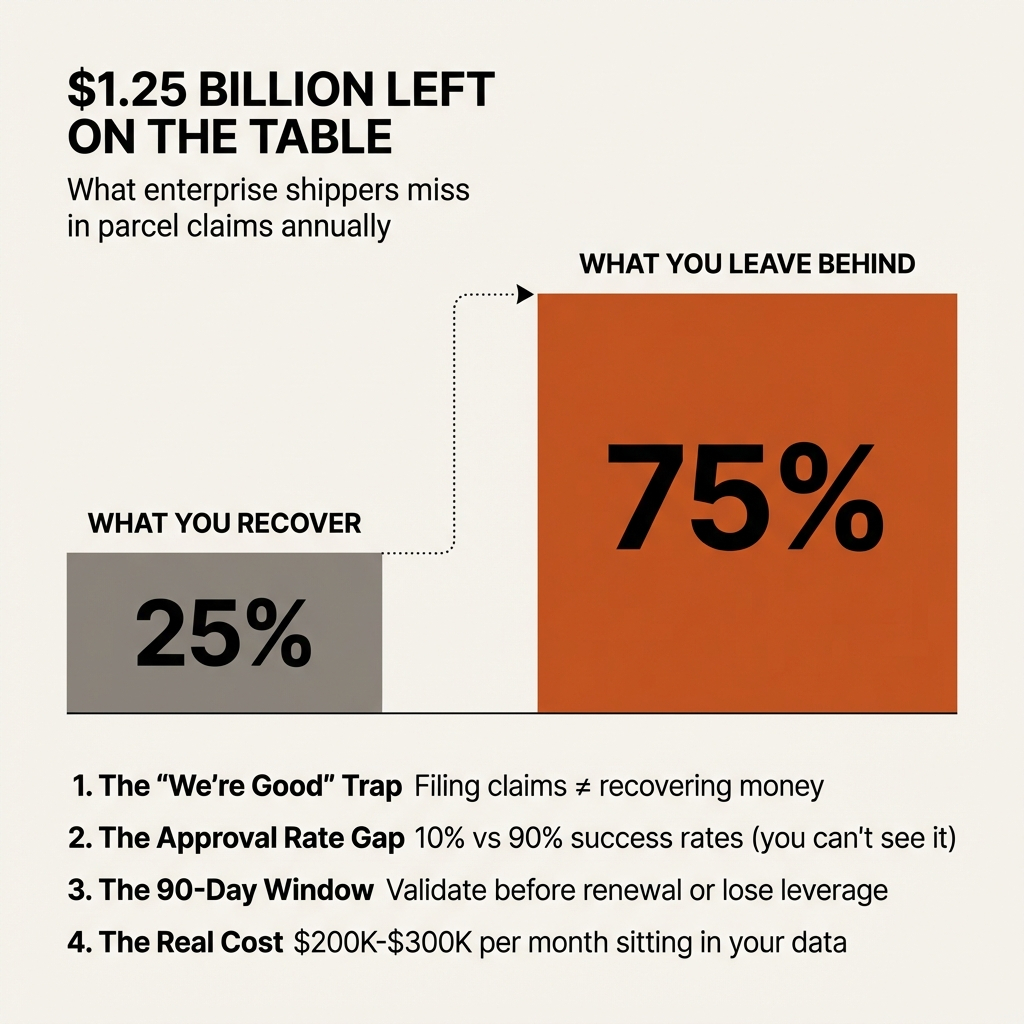
But filing claims and recovering money are not the same thing. 75% of parcel audit credits owed by UPS and FedEx go unclaimed every year. That represents $1.25 billion in credits that organizations assume they recovered but actually abandoned.
The gap between what you think is happening and what your data shows can run into hundreds of thousands of dollars per quarter. I've seen it repeatedly.
The 90 days before your carrier contract renewal is the most expensive time to discover this gap. Because at that point, you have no leverage and no time to fix the structural problems creating the leakage.
The "We're Good" Assumption
When I ask enterprise shippers about their claims recovery performance, I hear two versions of "we're good."
Version one: They have an existing claims process that isn't broken. Recovery looks normal based on their historical rates. They measure hard dollars per month or quarter, sometimes relative to shipping spend.
The problem is they're benchmarking against themselves. They have no external comparison data to know if their "normal" recovery rate is actually good or systematically underperforming.
Version two: They waived their rights to file claims in exchange for a carrier rebate. They no longer bear the burden of filing, so the problem feels solved.
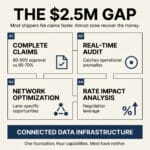
What they don't know is the margin carriers make on these rebates. I've seen rebates cover one-tenth to one-fifth of total recovery eligibility. You're trading $100 in potential recovery for a $10 to $20 rebate, then congratulating yourself for eliminating the hassle.
When we run an independent benchmark for shippers who took the rebate deal, the typical reaction is disbelief. We have to show them the supporting data. But once they understand the gap, they typically work with their carrier to remove the rebate and restore claims filing.
What Independent Validation Actually Reveals
ECS Tuning had a sophisticated in-house claims management process and team. They weren't flying blind. They had reports, tracking, and dedicated resources.
When we ran an independent assessment, we uncovered that eligible claims were getting missed and claims were being filed without adequate documentation. The gap totaled more than $200,000 per year.
This wasn't a failure of effort. It was a coordination problem that becomes invisible when you only benchmark against your own historical performance.
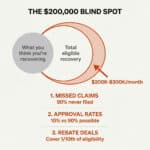
Another client was filing claims only when surfaced by their customers. About 250 claims per month on 400,000 shipments. They thought they had it covered.
Our data uncovered they were overlooking about 90% of their eligible claims. Around 3,000 claims per month. A $300,000 per month opportunity sitting in their shipping data, completely invisible to their internal process.
By the end of month two after we turned claims on, the customer had recovered more than $1 million.
The Approval Rate Gap You Can't See
Most shippers track claims filed. The number feels substantial. The activity looks productive.
But filed claims and approved claims are different metrics.
The gap between the two reveals process quality. For loss claims where there's no carrier proof of delivery, we see 90%+ success rates with well-organized shippers who submit proper documentation.
Shippers who aren't set up correctly or don't submit proper documentation see success rates above 10%.
That 10% might appear good to a shipper because they're benchmarking against their own historical payouts. They have no basis for comparison otherwise.
The approval rate gap gets amplified by setup complexity. With multi-brand enterprises or multi-channel fulfillment operations, claims must be organized, structured, and filed in accordance with carrier policies. The carriers are strict about shipper versus third-party claims filing. Documentation must be in order.
These requirements aren't published in accessible carrier documentation. You learn them by filing thousands of claims across dozens of enterprise shippers and seeing what gets approved versus what gets denied.
Why Internal Teams Can't See the Problem
Your internal team lacks external benchmarks. They don't have access to approval rate data across other shippers, other industries, or best-in-class claims operations.
The documentation to support proper claims filing processes at each carrier is severely lacking. Carriers don't publish clear guidelines. You figure it out through volume and pattern recognition.
This is why shippers find value partnering with a specialized provider. We unlock their highest potential approval rate by applying best practices and strategies we see across the best claims enterprises.
Your team can't access that knowledge base. They're operating with partial information, benchmarking against incomplete data, and assuming their performance is optimized because they have no evidence to the contrary.
The Data Decay Problem
Historical claims data ages fast. Q3 data doesn't predict Q1 performance.
With claims, you have hard eligibility windows. If it takes too long to assemble data or identify claim eligibility, you miss the filing window and lose recovery as a result.
Tracking data expires. Claims performance data is inconsistent and ebbs and flows during the year based on carrier volume strain and package volume.
Static benchmarks from six months ago tell you what was true then. They don't tell you what's happening now or what will happen during your peak season.
I remember looking at a spreadsheet of claims from an enterprise shipper filing more than 2,000 claims per week with UPS. Much of the static data was inaccurate. Broken vlookup formulas. Incorrect mappings.
The real problem was getting status updates from carriers in bulk was nearly impossible, given the volume of accounts used and the difficulty accessing this information via carrier portals.
Virtually every status was incorrect after a week. It was a huge manual effort for this team to download reports and map them into their spreadsheet. A nightmare.
This is what coordination failure looks like at scale. The tools break down. The data decays. The team can't keep up. And the organization has no visibility into how much money is slipping through the cracks.
Why 90 Days Before Renewal Matters
If you wait until contract expiration to start negotiating, the carrier can use that expiration date as leverage to encourage you to sign whatever paper they put in front of you.
You have no time to negotiate or explore alternative options.
From a planning standpoint, 90 days is critical based on turnaround times from conversation one through close. 120 days works. 90 days is the sweet spot.
Less than 90 days doesn't provide enough time to work through important deal points before the agreement lapses.
But the real reason 90 days matters is that's when you need validation data in hand. You need to know your actual claims performance, your actual approval rates, your actual recovery gaps.
That data becomes leverage. Claims rates inform true carrier performance. If you understand the true rates of service failure and can articulate these back to the carrier, it helps you create leverage in negotiations.
Without that data, you're negotiating blind. The carrier has data on millions of shipments across industries and business models. You have your own historical data and carrier-provided analysis.
That information imbalance means you enter renewals trusting carrier models that optimize for carrier yield, not shipper recovery.
What Validation Actually Looks Like
When we run an independent validation assessment, the process takes days, not months.
The shipper connects their carrier data streams to our system. We support 10 domestic parcel carriers and counting. Our system does two things, both automated.
First, we scan all their claims activity and baseline their existing claims rates and recovery. We flag any claims stuck in process that require details to unlock and move forward.
Second, we scan and evaluate all their shipments to determine if there were any claims missed that should have been filed.
This creates an opportunity analysis to unblock stuck claims and add missed claims. Often missed claims are greater than what's being filed today.
We've run this assessment for hundreds of shippers. We haven't found a single customer in the "we're actually good" minority. The eligibility gap exists everywhere we look.
The Rent the Runway Discovery
During our mid-pilot check-in with Rent the Runway, we presented results showing $441,000 recovered in 14 days across 4,100 claims. Another $206,000 was pending from 1,400 additional claims.
But the bigger discovery came from the contract optimization analysis. RTR was overspending by approximately 12.9% weekly with UPS. That represented a $7.7 million annualized savings opportunity through renegotiation.
The complexity and trade-offs of their current UPS rebate structure became clear during the discussion. We recommended shifting value from rebates to upfront discounts.
This is what independent validation uncovers. Not just claims recovery gaps, but structural contract problems that compound over time as your shipping profile changes.
Parcel agreements are negotiated based on a snapshot of your shipping profile at a specific point in time. But product assortments shift. Packaging changes. Residential delivery grows. Average dimensions increase slightly but consistently.
Over time, these changes move you away from the assumptions that underpinned the original agreement. Without continuous validation, the gap between contract terms and operational reality widens systematically.
The Performance Threshold That Demands Intervention
I draw a clear line on claims recovery standards.
Any positive resolution rate below 80% for loss without proof of delivery is not optimized.
That's the threshold. Below 80%, you have a structural problem that needs infrastructure intervention, not just process tweaking.
The reason that threshold matters is it separates coordination failure from execution gaps. Above 80%, you might have training issues or documentation gaps. Below 80%, your data connectivity is broken or your process setup violates carrier requirements.
You can't fix structural problems with more effort. You need different infrastructure.
What You Should Actually Measure
Activity metrics include time spent managing claims and claims-related processes. Claims filed. Output metrics.
Recovery metrics are dollars landed in the bank account. That's where the rubber meets the road. The real outcome metric to marry with the output and activity metrics.
The outcome metric must justify the activity.
Most organizations track activity because it's visible and feels productive. But activity without recovery is just expensive motion.
We boost activity metrics by shifting them from customer teams to our software. We boost outcome metrics by lifting recovery.
The difference between the two reveals whether your claims process is working or just busy.
The Carrier Counterparty Reframe
Most shippers treat carriers as adversaries in the claims process. Something to be gamed or pressured.
That framing creates friction that hurts both sides.
We believe claims are pain points for carriers and enterprise shippers. Removing the friction in the middle makes claims filing easier and ensures that claims hitting carriers' desks are valid with complete documentation.
This benefits both sides of the claims equation. Removing the friction removes a potential blocker in negotiations.
When you shift from adversarial to counterparty framing, different conversations become possible. You're solving a shared coordination problem rather than fighting over money.
Carriers benefit from reduced garbage claim volume and complete information submissions. Better input quality reduces carrier processing costs while improving shipper recovery rates.
That alignment opportunity only exists when you stop treating carriers as pure adversaries.
What Happens When You Don't Validate
Nine out of 10 shippers overspend, with businesses routinely overpaying by 15% to 30% because they haven't validated actual performance against contract terms.
The pattern persists because over two-thirds of shipping decision makers don't negotiate custom shipping rates with carriers. They operate under the assumption that their volume doesn't justify validation.
This is the "we're good" pathology at scale.
Without validation, you're renewing contracts based on assumptions that may have been true three years ago but no longer match your operational reality.
You're leaving money on the table in two places. First, in unclaimed credits and missed claims. Second, in contract terms that don't reflect your actual shipping profile or service failure rates.
The combined impact runs into millions of dollars annually for enterprise shippers.
The Real Question
You probably have a claims process. You probably file claims regularly. You probably recover some money.
But do you know your approval rate? Do you know what percentage of eligible claims you're missing? Do you know how your recovery performance compares to best-in-class operations?
If you're heading into carrier contract renewal in the next 90 days, you need answers to those questions before you sit down at the negotiating table.
Because the gap between what you think is happening and what's actually happening in your data is probably larger than you realize.
And the most expensive time to discover that gap is when you no longer have time to fix it.