I've spent seven years inside parcel data streams watching enterprises file claims and then walk away from money.
It's not laziness. It's not bad process.
It's what happens in the two weeks after you hit submit.
The carrier receives your claim. Issues a reference number. Then goes quiet.
Your team filed the claim, checked the box, moved on to the next fire. The claim sits in a carrier queue with no status update. Days turn into weeks. Weeks turn into months.
When I measured this across 74.5 million shipments, the pattern was surgical in its consistency.
88% of abandoned claims have a claim number but no carrier status. They averaged 548 days of dormancy. The carrier accepted them. Then nothing.
The money didn't disappear because the claim was invalid. It disappeared because nobody owned the gap between filing and resolution.
The Real Cost of Walking Away
For a company shipping 100,000 packages monthly, the math is straightforward.
You'll generate roughly 345 loss claims per month at the industry average rate of 3.45 per 1,000 shipments.
If you're in the bottom quartile of follow-through performance, 41.1% of those claims go unresolved. That's 142 claims per month sitting in carrier systems with no closure.
Among resolved claims in that same quartile, the win rate is 39.5%. Apply that rate to the abandoned pool and you're looking at 56 claims per month that would have paid if someone had followed through.
At $108 average payout per won claim, that's $6,052 monthly. $72,621 annually.
The number scales linearly. At 250,000 shipments per month, you're looking at $181,000 per year left on the table.
This isn't theoretical. It's what happens when you treat claims as a filing event instead of a resolution process.
What Actually Happens After You File
The carrier doesn't adjudicate your claim the moment you submit it.
They run a parallel process. A trace. An investigation. A delivery confirmation check.
When that process completes, they either pay you, deny you, or ask for more information.
The problem shows up in that third category.
Across 13,000+ denied claims I analyzed, 28% were denied for data or documentation gaps the carrier explicitly requested. The carrier asked. Nobody answered. The claim died.
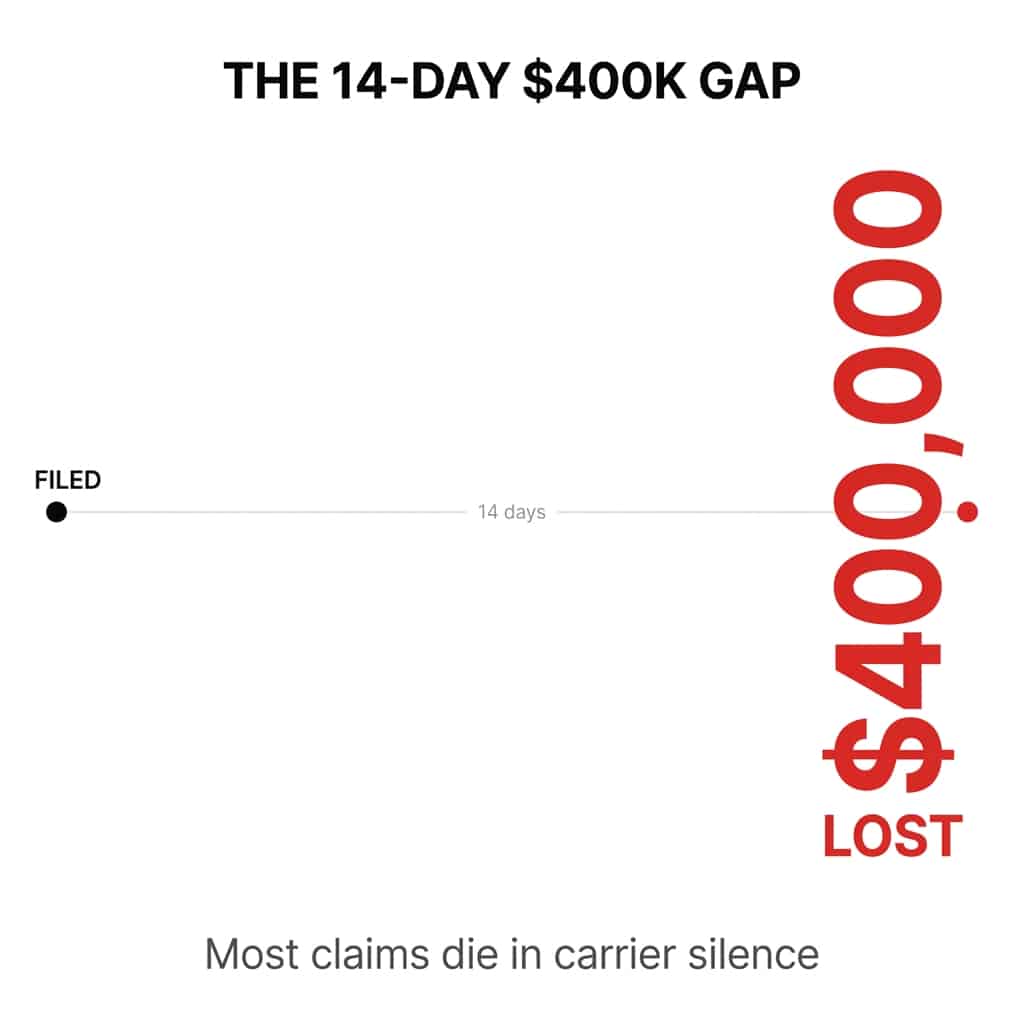
Those 4,091 data-gap denials represented $432,000 in eligible claim value denied for addressable reasons. The carrier didn't say the package wasn't lost. They said they needed something you didn't provide.
When I tracked what happened to claims where carriers requested additional documentation, the eventual payment rate was 0.3%.
The loop almost never completes. The carrier asks, the request sits in an inbox, the claim ages out.
The Two Clocks That Determine Everything
Most people think filing speed matters. File fast, get paid fast.
The data says something different.
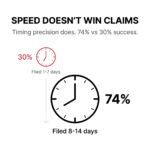
Claims filed within the first 7 days of shipment succeed at 29.8%. Claims filed between 8 and 45 days succeed at 71-78%.
That's a 40-point gap driven by a mechanism most teams don't see.
There are two clocks running. One is the carrier's filing deadline. You have to beat that or you're ineligible.
The other is the carrier's internal trace window. The package has to miss its expected delivery date. A trace has to be initiated. The trace has to come back inconclusive.
Only then will the carrier treat the shipment as genuinely lost.
When you measure filing lag from expected delivery date instead of ship date, the pattern sharpens considerably:
- Claims filed on or before expected delivery: 16% success rate
- Claims filed 1-3 days after expected delivery: 34%
- Claims filed 8-14 days after expected delivery: 74%
- Claims filed 15-30 days after expected delivery: 76%
The inflection isn't at "file immediately" versus "file slowly." It's at "file before the carrier has completed its trace" versus "file after the carrier has exhausted its ability to find the package."
A human trying to "file fast" will systematically file too early on some portion of claims and take the 29% success rate hit.
A system that monitors carrier scan events and waits for the trace window to close before filing captures the 74-76% success rate band consistently.
The value isn't speed. It's precision about when to file.
Why Follow-Through Infrastructure Beats Filing Speed
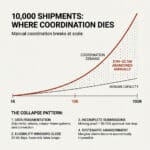
I analyzed claim resolution patterns across 14 large enterprise accounts shipping 10,000+ packages weekly.
84% of paid claims resolve within 14 days of filing. The median paid claim resolves in 4 days.
But unresolved claims have been dormant for an average of 326 days since last system action.
The gap isn't that some claims take longer to process. It's that some claims enter a state where nobody is checking anymore.
When I looked at what differentiates top-quartile accounts from bottom-quartile accounts, it wasn't filing volume or claim quality.
Top-quartile accounts leave 12.8% of claims unresolved. Bottom-quartile accounts leave 41.1% unresolved.
The difference is what happens after the carrier goes quiet.
Top-quartile accounts have systematic follow-through infrastructure. The system checks carrier status on a regular cadence. When a claim sits without movement for more than 14 days, it triggers a different action: resubmission through a different channel, escalation to a carrier account rep, or explicit deadline chase before the filing window expires.
Bottom-quartile accounts treat silence as pending and eventually stop checking.
The structural name for this failure is a missing ownership handoff. In a manual system, a human would decide whether to call the carrier, submit a dispute, or write off the claim.
In an automated system without that decision logic built in, the claim falls into a third category that doesn't formally exist: not paid, not denied, not actively being worked.
The Carrier Isn't Your Adversary
I used to think carrier adjudication was adversarial. File a claim, fight for payment, extract money from a resistant system.
The data doesn't support that framing.
Carriers aren't partners who reward better input with better decisions. But they're not adversaries either.
They're processing systems with rules.
When you meet the timing requirement and the documentation requirement, the carrier's own process completes cleanly and payment follows.
When you don't meet the timing requirement, the carrier's process is still running and it generates a delivery-confirmation denial.
When you don't meet the documentation requirement, the carrier asks and then denies anyway when you don't respond.
The strategic insight isn't "give the carrier what it needs so it wants to pay you." It's "understand the carrier's internal process well enough to file at the moment when that process has already concluded the shipment is lost, with the documentation required to close the adjudication."
That's a more mechanical and ultimately more accurate description of what's happening.
Across large shippers in 2025, I tracked time to first carrier response. Claims with transport value populated averaged 20 days. Claims missing transport value averaged 45 days.
That's not the carrier being difficult. That's the carrier's system waiting for required data before it can route the claim to an adjudicator.
What Changes When You Solve Follow-Through
I tracked 226 accounts with comparable before-and-after data spanning an average of 11 months each.
74% saw loss claim volume increase after implementing systematic follow-through infrastructure. The median increase was 108%. The average was 154%.
But volume isn't the metric that matters to a CFO.
Recovery is.
Average monthly loss claim recovery increased 3× across this population. The median account saw a 2.2× increase.
For the 14 large-shipper accounts I analyzed in detail, the before number was $171,000 per account annually. The after number was $577,000.
That's a $406,000 per account incremental, running at roughly $27,000 per month.
The delta started within the first three months and has been consistent for 15 months across 14 accounts.
This isn't a projection. It's a mean and a median from a defined population.
The mechanism isn't that these accounts suddenly got better at filing claims. They already knew how to file.
What changed was that claims no longer disappeared into carrier queues with no follow-up.
The system checks status. When the carrier requests documentation, it routes the request to the right person with the right context. When a claim sits dormant for more than 14 days, it triggers escalation logic.
The human workload decreased by roughly 98%. The recovery rate increased from 39.5% to 71%.
The Revenue Line You're Not Tracking
When a carrier pays a claim, the money doesn't reduce a freight expense on your P&L.
It arrives as a carrier credit, typically applied to accounts receivable or recognized as other income.
This is cash coming in that wasn't coming in before.
Across the 14 large-shipper accounts I analyzed, monthly claim recovery has been positive in 99% of account-months. The floor month across the network was $137,000. The ceiling was $805,000.
Per account, the median monthly run rate is $23,900, annualizing to $287,000.
The coefficient of variation is 0.65. There's variability, but it's the variability of a real revenue line.
You can put $250,000-$350,000 per account per year in the budget with reasonable confidence, flag months above $500,000 as upside, and treat anything below $100,000 as a signal to investigate data quality or filing cadence.
That's what a revenue line looks like. It has a floor, a range, and a story when it deviates.
The ratio that reframes the conversation: claim recovery averages 0.76-0.95% of shipping spend.
For a company spending $30 million per year on freight, that's $230,000 to $285,000 per year in claim recovery.
This isn't a rounding error. It's a line item that belongs in the annual budget conversation alongside freight rate negotiations and carrier contract renewals.
What You're Actually Solving For
The problem isn't that your team doesn't know how to file claims.
The problem is that filing is treated as the end of the process instead of the beginning.
You file. The carrier acknowledges. Then silence.
Without systematic follow-through infrastructure, that silence becomes abandonment.
The claims sit in carrier queues for 548 days on average. The money disappears because nobody owns the gap between filing and resolution.
When you solve follow-through, three things change:
First, you file at the right time. Not immediately after shipment, but after the carrier's trace window closes. That timing precision alone moves success rates from 30% to 74%.
Second, you maintain momentum. The system checks carrier status on a regular cadence. When the carrier requests documentation, it routes the request immediately. When a claim sits dormant, it triggers escalation logic.
Third, you convert claims into a predictable revenue line. Recovery becomes something you can forecast, budget, and measure month over month.
The $72,000 annual gap at 100,000 shipments monthly isn't a ceiling. It's a floor.
It's the cost of abandonment specifically. It doesn't include claims never filed in the first place, which is a larger number.
What you're solving for isn't just the money you're leaving on the table today. It's the infrastructure that turns claims from a reactive cost center into a systematic revenue recovery process.
The 14-day window after filing is where most companies lose. It's also where the opportunity sits.