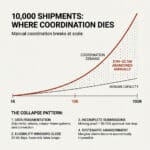
85 million packages arrived damaged in 2024. A 30% increase from the previous year.
For enterprise shippers moving 10,000+ boxes weekly, that 1% loss rate translates to thousands of packages and hundreds of thousands of dollars in recoverable value every year.
The instinct is to file faster. Build better forms. Streamline submissions.
But the data shows something counterintuitive: speed of filing has almost no correlation with recovery rates. The bottleneck isn't getting claims in. It's following through after they're filed.
The Real Problem Hiding in Plain Sight
Across 74.5 million shipments tracked on ShipScience, we measured 256,988 loss claims filed by 417 enterprise accounts. The filing rate is 3.45 claims per 1,000 shipments.
That number tells you detection is working. Claims are getting filed.
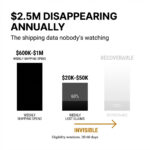
But here's what the data reveals about what happens next: 41.1% of claims in bottom-quartile accounts go unresolved. They have claim numbers. They were accepted by carriers. Then they sit dormant for an average of 326 days without a single system action.
These aren't denied claims. They're abandoned claims.
At 100,000 shipments per month, that abandonment rate costs $72,621 per year in eligible claim value that was filed but never closed. For a company shipping 250,000 packages monthly, the median enterprise shipper on our platform recovers $216,000 annually from loss claims alone.
The gap between those two numbers isn't about filing volume. It's about what happens in the 120 days after the carrier acknowledges your claim.
Why Speed Doesn't Matter the Way You Think It Does
Most people assume faster filing means better outcomes. File immediately, beat the deadline, maximize recovery.
The data breaks that assumption in a specific, measurable way.
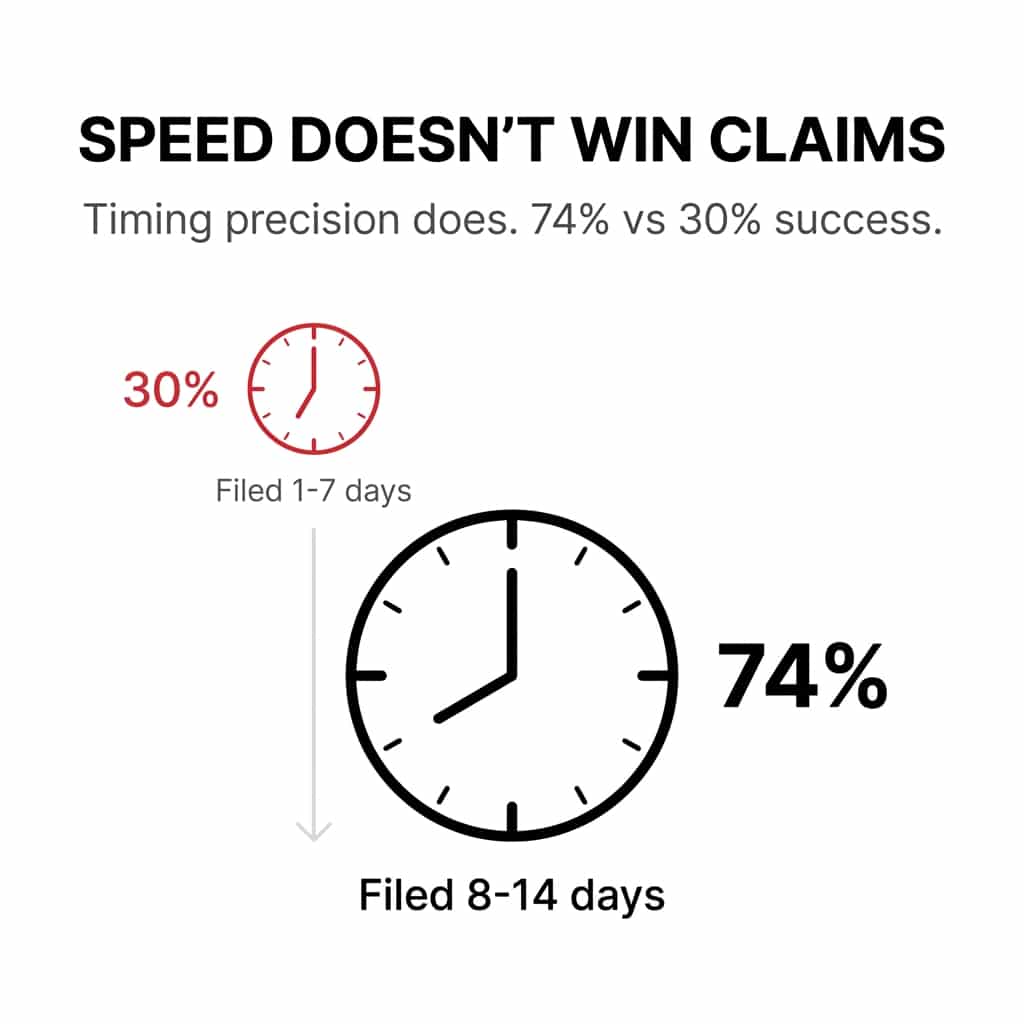
Claims filed within the first 7 days of shipment succeed at 29.8%. Claims filed between 8 and 45 days succeed at 71-78%. That's a 40-point gap.
When you look at why early claims fail, the answer is in the carrier status details. 39% of claims filed in the first 7 days are denied with "Signature Option Not Requested" combined with delivery-confirmed denials.
These aren't lost packages. They're packages that were in transit, filed against before the carrier had even completed its delivery window. The carrier found them, delivered them, and denied the claim because the shipment wasn't actually lost.
The mechanism is that loss claims require the carrier to have failed at delivery. Carriers have an internal process: the package has to miss its expected delivery date, a trace has to be initiated, the trace has to be inconclusive before the carrier will treat a shipment as genuinely lost.
Filing a claim before that process has run its course means you're filing against a shipment the carrier hasn't confirmed as missing yet.
The Two-Clock Framework
There are two clocks running on every claim. Most people only see one.
Clock 1: The filing deadline. You must file before this expires. This is the clock everyone watches.
Clock 2: The carrier's trace window. The carrier needs 8-14 days past expected delivery to exhaust its search process. This is the clock that governs outcomes.
When you measure filing lag not from ship date but from expected delivery date, the pattern sharpens:
- Claims filed on or before expected delivery: 16% success rate
- Claims filed 1-3 days after expected delivery: 34%
- Claims filed 8-14 days after expected: 74%
- Claims filed 15-30 days after: 76%
The inflection isn't at "file immediately" versus "file slowly." It's at "file before the carrier has completed its trace" versus "file after the carrier has exhausted its ability to find the package."
Once a carrier has looked for a shipment for 8-14 days past expected delivery and come up empty, its adjudicators know they're looking at a genuine loss. Before that, they still have open search processes and the claim competes with active delivery attempts.
The Bottleneck Is Documentation, Not Speed
The most common reason for a claim being denied is incomplete information. Missing invoices, delivery receipts, or inspection reports make it difficult to prove responsibility or value.
Across 13,000+ denied claims from large shippers in 2025, denials fall into three categories:
- 44% are outcome denials — the carrier confirmed the package was delivered
- 25% are policy or liability denials — the shipment wasn't covered under the carrier's liability terms
- 28% are data or documentation gap denials — the carrier explicitly said it needed something it didn't have
That 28% represents $432,000 in eligible claim value denied for addressable reasons across the large-shipper cohort.
But here's what's striking: those 4,091 data-gap denied claims have a 0.3% eventual payment rate. The carrier asked for more information, and in almost every case the outcome was still denial.
The "carrier asks, shipper provides, carrier pays" loop almost never completes in the data.
What Actually Works
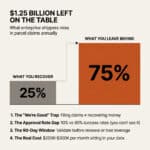
For large shippers on ShipScience, three fields drive the difference between 30% and 75% success rates:
- Transportation value on every claim
- Recipient name on every shipment label for FedEx volume
- Substantive merchandise description on every claim record
Remove the transport value field and the time to first carrier response jumps from 20 days to 45 days on suboptimal filings. That's the one measurable carrier behavior change from data quality.
Everything else is either already handled by the platform or not materially affecting outcomes in this population.
The Structural Reason Claims Get Abandoned
88% of bottom-quartile abandoned claims have a claim number but no carrier status. Ever.
The carrier accepted the claim, issued a reference number, and then went silent. The system checked back for an average of 3.1 days, made 5.3 attempts, got no response, and stopped.
Those claims are now sitting dormant for an average of 548 days.
They weren't denied. They weren't paid. They simply exist in a state where neither side took another action.
The filing timing is the mechanism. Bottom-quartile abandoned claims were filed an average of 61 days after shipment — outside the optimal 8-45 day window, and 30% were filed after 60 days.
FedEx makes up 96% of these abandoned claims. When you cross this against the carrier timing analysis, FedEx's adjudication process for claims filed late appears to stall rather than formally deny.
The carrier doesn't reject the claim. It acknowledges it, issues a number, and then parks it in a queue that never moves. There's no explicit denial the system can detect and respond to.
There's just silence.
The Missing Handoff
The actual coordination failure is this: claim filing and initial follow-up is automated. But when the carrier goes silent — specifically on FedEx claims filed after the optimal window — there is no escalation path that treats "no response after 5 attempts" as a signal requiring a different action.
The system interprets silence as pending and eventually stops checking.
What it should do is flag those claims as requiring a different intervention: resubmission through a different channel, a carrier account rep contact, or an explicit deadline chase before the filing window expires entirely.
The structural name for this failure is a missing ownership handoff.
In a manual system, a human would decide whether to call the carrier, submit a dispute, or write off the claim. In an automated system without that decision logic built in, the claim falls into a third category that doesn't formally exist: not paid, not denied, not actively being worked.
The 548 days of dormancy isn't negligence. It's the absence of a defined next action when the carrier's response loop breaks down.
What Top-Quartile Accounts Do Differently
The difference between bottom and top quartile on abandonment isn't that top-quartile accounts are more diligent.
Top-quartile abandoned claims average 53 days ship-to-file — closer to the optimal window — and stay active 16 days before going dormant. The system gets more carrier response signals from well-timed claims, which means more checkpoints where the automation can route to the right outcome.
Poorly-timed claims generate silence from the carrier immediately, which creates a void the system has no instruction to fill.
Top-quartile accounts on ShipScience maintain:
- 12.8% unresolved rate (vs. 41.1% for bottom quartile)
- 69% win rate among resolved claims (vs. 39.5% for bottom quartile)
- $133 average payout per won claim (vs. $108 for bottom quartile)
At 100,000 shipments per month, that performance gap represents $24,155 per year in the strict delta calculation between what bottom-quartile accounts lose to abandonment and what top-quartile accounts lose.
The honest caveat: this $72k is the cost of abandonment specifically — claims filed and not closed. It doesn't include claims never filed in the first place, which is a larger number but harder to measure precisely.
The Infrastructure That Actually Solves This
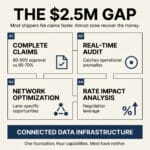
Follow-through infrastructure has four components:
- Detection layer that watches every shipment
- Filing layer that submits claims automatically
- Status monitoring layer that polls carrier systems on a regular cadence
- Resolution layer that records outcomes and flags anything requiring human action
The attempts field is the heartbeat of that monitoring loop. 1.7 average attempts on paid claims means the system filed, checked once, got a payment status, and closed. 4.2 attempts on denied claims means it filed, checked, saw a pending status, checked again, saw a denial, and recorded it.
What it is not: a fully autonomous system for every scenario. The 1.7% of claims requiring human action is a real number.
For a company filing 4,400 loss claims per year — the large-shipper average — that's roughly 75 claims per year that need a human to submit a document or make a phone call.
That's manageable.
What it's replacing is the alternative: 4,400 claims per year that a human would need to file, monitor, and chase, where the unresolved rate without automation is 14-41% depending on the account.
The infrastructure reduces the human workload by roughly 98%, routes the remaining 2% to the right people with the right context, and produces a 71% success rate on everything it touches.
Why Data Connectivity Comes First
The first thing that breaks without data connectivity is timing precision, which is the highest-leverage variable in the entire system.
The two-clock framework — file after the carrier's trace window closes — requires knowing when the shipment was supposed to arrive. Without a ship date, the system is filing blind into timing space.
Claims with no ship date have a 30% success rate, identical to claims filed too early. Claims in the optimal 8-45 day window have a 58% success rate.
That 28-point gap is entirely a connectivity problem. You can add all the automation, all the follow-through logic, all the resubmission rules you want, and none of it closes that gap if the system doesn't know when the shipment was supposed to arrive.
The second thing that breaks is detection completeness. 36% of pre-ShipScience claims in our data have no shipment record at all. Those are claims someone filed manually, from memory or from a customer complaint, with no systematic connection to the shipment data.
The detection rate for a manual, connectivity-free process is roughly 2.3 claims per 1,000 shipments. A connected system files 3.0-3.5 per 1,000.
That 30-50% detection gap isn't a process failure. The process worked fine on the claims it saw. It never saw the other third.
Optimizing a process that starts from an incomplete detection layer is optimizing the visible fraction while the invisible fraction stays invisible.
The Pattern Across 226 Accounts
Across 226 accounts with comparable before/after data, 74% saw loss claim volume increase after onboarding ShipScience, with a median increase of 108% and an average of 154%.
26% saw volume decline, and they were already sophisticated filers coming in at roughly three times the rate of accounts that grew. ShipScience rationalized their process rather than replacing a gap.
But here's what changed on recovery: average monthly loss claim recovery increased 3× across the cohort, driven primarily by accounts that had been leaving claims entirely unfiled. The median account saw a 2.2× increase.
For large shippers — 10,000+ packages per week — ShipScience is recovering a median of $216,000 annually from loss claims alone, with a 71% success rate on the claims we file and 5.7% left unresolved.
At 250,000 shipments per month, that unresolved 5.7% still represents $24,000 per year sitting in carrier queues.
The complete honest statement: filing more claims matters when you're starting from reactive, complaint-driven detection. But once you're filing systematically, the next lever isn't volume. It's follow-through infrastructure that closes the 326-day dormancy gap and captures the 28-point timing precision advantage.
What This Means for Enterprise Operations
Claim recovery averages 0.76-0.95% of shipping spend across the large-shipper cohort. For a company spending $30M per year on freight, that's $230K to $285K per year in claim recovery.
That's not a rounding error. That's a line item that belongs in the annual budget conversation alongside freight rate negotiations, carrier contract renewals, and surcharge audits.
The before/after data for 14 large-shipper accounts shows average recovery per account of $171K before ShipScience and $577K after — a $406K per account incremental, running at roughly $27K per month.
That delta started within the first three months and has been consistent for 15 months across 14 accounts.
The transformation isn't tactical. It's structural. You're moving from reactive chaos to continuous operational clarity. The cost savings are immediate, but the deeper shift is having a system that doesn't forget, doesn't go silent, and doesn't leave money on the table because someone got busy.
What would your operation look like if 98% of the follow-through happened automatically, and the remaining 2% landed on the right desk with all the context already attached?